The Headline: A Quiet, Confident Green Day
India’s stock markets closed higher on June 17, 2026, with a broad-based rally that felt less like excitement and more like quiet confidence.
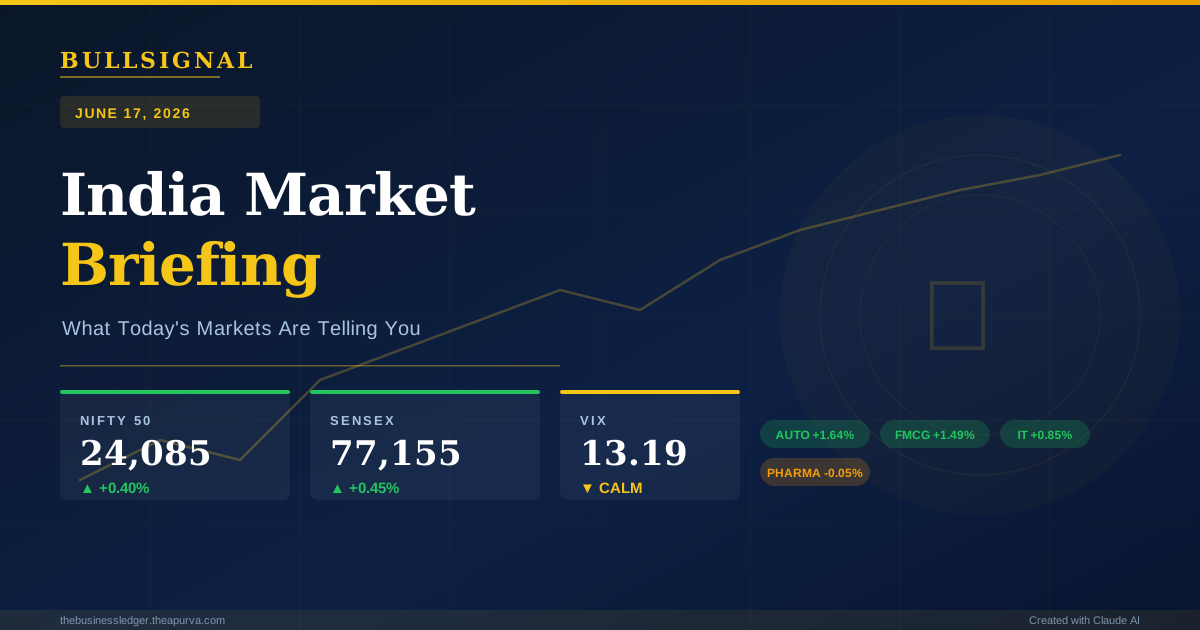
NIFTY 50 — think of it as the report card for India’s 50 biggest companies — ended the day at 24,085.7, up 96 points (+0.40%). When NIFTY goes up, it means investors across the country are feeling optimistic about the near future. When it falls, it means caution is spreading.
SENSEX, which tracks 30 of India’s largest and most established companies listed on the Bombay Stock Exchange, closed at 77,155.62, gaining 347 points (+0.45%). Both indices moving together in the same direction is a healthy sign — it tells us this wasn’t a fluke in one exchange but a real, consistent market mood.
The day’s story wasn’t about fireworks. It was about breadth: Auto, FMCG, IT, and Banking all gaining together is what market professionals call a “broad rally” — and it’s a much better sign than just one sector pulling everything up.
Sectors: Where the Money Moved — and Why
🚗 NIFTY Auto: The Day’s Star (+1.64%)
Auto stocks were the clear winner today, with the NIFTY Auto index jumping 1.64%. Bajaj Auto rose 1.04%, hitting ₹10,042, while Ashok Leyland and TVS Motor also gained.
Here’s the cause-and-effect chain that matters: When India’s rural economy is doing well, two-wheeler sales pick up. When fuel prices are stable or falling, passenger car and commercial vehicle demand stays strong. When interest rates hold steady (as the RBI has been signalling), people feel comfortable taking car loans. Put all three together, and you get Auto stocks rising.
What does this mean for your daily life? If you work in or around the auto sector — as a dealer, supplier, parts manufacturer, or even a mechanic — today’s move is a quiet thumbs-up for the sector’s health.
🛒 NIFTY FMCG: Consumer India Feeling Good (+1.49%)
FMCG stands for Fast Moving Consumer Goods — this is the sector that includes companies making the products you buy every week: biscuits, soaps, shampoos, packaged food, beverages. Nestlé India rose 1.12%, Britannia gained 0.28%.
When FMCG stocks rise, it usually signals one of two things: either investors expect rural incomes to improve (which drives demand for packaged goods in smaller towns), or inflation is expected to cool (which means these companies can protect their profit margins). Today, it likely reflects both.
The real-world impact: strong FMCG sector health means the companies making your everyday groceries are profitable and confident enough to invest in their supply chains. That often means better availability, steadier prices, and eventually, more jobs in distribution and manufacturing.
💻 NIFTY IT: The Dollar Story (+0.85%)
Indian IT companies — TCS (+1.09%), Infosys (+1.23%), Wipro (+0.99%), HCL Tech (+0.67%) — all moved higher today.
Here’s why this matters and how it connects to something you might not immediately associate with software companies: Indian IT firms like TCS and Infosys earn most of their revenue in US dollars (from American and European clients), but they pay their employees’ salaries in Indian rupees. So when the US dollar is strong relative to the rupee, every dollar they earn is worth more in rupees — it’s like getting an automatic pay raise without changing a single line of code.
A stronger IT sector also means more high-paying jobs in Bengaluru, Hyderabad, Pune, and Chennai — which trickles into higher real estate demand and spending in those cities.
🏦 NIFTY Bank: Steady and Solid (+0.50%)
Banks had a good day, but it was the public sector banks that led. State Bank of India rose 1.10%, Bank of Baroda surged 2.36%, and IndusInd Bank gained 1.10%. Private banks like Axis Bank (-1.08%) and Kotak Mahindra Bank (-0.82%) faced some selling pressure.
This split between public and private banks is interesting. Public sector banks have been riding a wave of improved asset quality and government capex spending — when the government builds roads, railways, and ports, it borrows money from banks and pays them back with interest. That’s why SBI is doing well.
For you as a home loan borrower: the banking sector’s health is directly tied to whether the RBI will cut interest rates. A strong, stable banking sector gives the RBI more confidence to reduce rates — which would lower your EMI.
🏗️ Capital Goods & Defence: The Quiet Rocket (+4.81% for HAL!)
This deserves a separate mention. HAL (Hindustan Aeronautics Limited) surged 4.81% today, BEL (Bharat Electronics Limited) rose 3.02%, Siemens gained 2.43%, and ABB jumped 2.04%.
Defence and capital goods stocks are surging because India’s government continues to spend aggressively on infrastructure and defence manufacturing — a programme it has been running for years under “Make in India.” When the government announces contracts for fighter jets, radar systems, or power equipment, companies like HAL and BEL see their order books fill up, which is exactly what investors are betting on.
For ordinary Indians, this matters because defence manufacturing creates skilled jobs in engineering and aerospace — and it reduces the amount India spends on importing weapons from foreign countries, which is good for the rupee.
💊 NIFTY Pharma: Nearly Flat (-0.05%)
Pharma was essentially unchanged today. Cipla fell 1.63%, Dr. Reddy’s slipped 0.62%, but Sun Pharma rose 1.09% and Aurobindo Pharma gained 1.84%. The sector is in a wait-and-watch mode, likely ahead of US FDA news or quarterly earnings updates.
Pharma’s sluggishness doesn’t mean trouble — it often means investors are taking profits after a strong run and waiting for the next clear signal.
FII vs DII: Who’s Buying, Who’s Selling
FII stands for Foreign Institutional Investors — these are big overseas money managers: US pension funds, European hedge funds, Gulf sovereign wealth funds. They move billions across global markets every day.
DII stands for Domestic Institutional Investors — India’s own mutual funds, insurance companies like LIC, and pension funds. When you invest via a SIP (Systematic Investment Plan), your money often goes through a DII.
Today’s official FII and DII data for June 17 is pending from the exchanges (typically released after 6 PM IST). However, the broad-based market rally with buying across all major sectors suggests net positive institutional participation. The pattern is consistent with what we’ve seen this week: Indian investors have been providing a stable floor even on days when foreign funds are cautious.
If you invest via SIP: Every month, DIIs systematically deploy your SIP money into markets. On green days like today, they’re buying at slightly higher prices — but that’s fine. The power of SIP is in riding through all kinds of markets, not timing individual days.
India VIX: The Fear Index Says “Relax”
India VIX measures market fear. Think of it as a thermometer for investor anxiety:
- Below 15 = calm markets, low volatility
- 15–20 = mild concern, some nervousness
- Above 20 = investors are worried
- Above 30 = near-panic (like March 2020 during COVID)
Today, VIX fell 8.10% to just 13.19 — one of the lowest readings in recent months. This is excellent news for market stability.
A VIX of 13.19 means: investors are NOT expecting sharp swings in the near term. They’re calm. They see no big threats on the horizon. For you as an investor, low VIX periods are often good times to stay the course with your existing investments — markets tend to grind higher slowly during these calm phases.
What could disturb this calm? A surprise from global central banks, unexpected geopolitical tension, or a major domestic economic announcement. But as of today, the market is relaxed.
Real-World Impact: From Markets to Your Life
Your EMI & Home Loan: The banking sector’s health and VIX reading both point toward a stable rate environment. The RBI is unlikely to surprise markets with a sudden rate hike when indices are calm and banks are healthy. Your existing EMIs are safe; if you’re planning a home loan, conditions look favourable.
Your Petrol Price: ONGC fell 1.29% today, signalling some weakness in energy stocks. Global crude oil prices have been range-bound. For India — which imports over 85% of its crude oil — stable or softening oil prices are a big deal. Every dollar fall in crude oil saves India roughly $1.5 billion a year in import costs. Expect petrol and diesel prices to remain stable in the near term.
Grocery Prices: FMCG sector strength suggests companies like HUL and Nestlé aren’t facing raw material cost pressure. That’s good news — price stability in packaged goods means the inflation that erodes your household budget is staying in check.
Your Job Market: IT and capital goods sectors both rising is a positive signal for skilled employment. If you’re in tech, engineering, defence manufacturing, or FMCG distribution, today’s numbers are good news for your sector’s hiring environment.
Your SIP Portfolio: A calm VIX, green indices, and broad sectoral participation — this is the kind of day where your SIP portfolio likely showed a small gain. Don’t celebrate too much, and don’t get nervous on red days. The point of SIP is consistency over years, not weeks.
What to Watch Tomorrow
1. FII Activity: Watch whether foreign funds are net buyers or sellers. If they buy aggressively, NIFTY could test 24,200–24,300. If they sell, the market might give back some of today’s gains. The directional signal from FIIs will set the tone for the week.
2. Global Cues — US Fed: Any comments from the US Federal Reserve or updated inflation data from America can move markets sharply. A hint of US rate cuts strengthens the rupee and draws FII money into Indian markets; a hawkish surprise does the opposite. Keep an eye on global news tonight.
3. Auto & Capital Goods: Today’s strong performance in these sectors makes them worth watching. If global commodity prices remain stable and government spending data shows continued momentum, Auto and Capital Goods could extend their rally. Companies like Bajaj Auto, HAL, and Siemens are key ones to track.
Today was a day for patient investors to feel quietly vindicated. No drama, no crash, no bubble — just a market doing what healthy markets do: climbing carefully, one step at a time.
Created with Claude AI