The Headline: IT Dragged Markets Down, But Domestic Investors Held the Floor
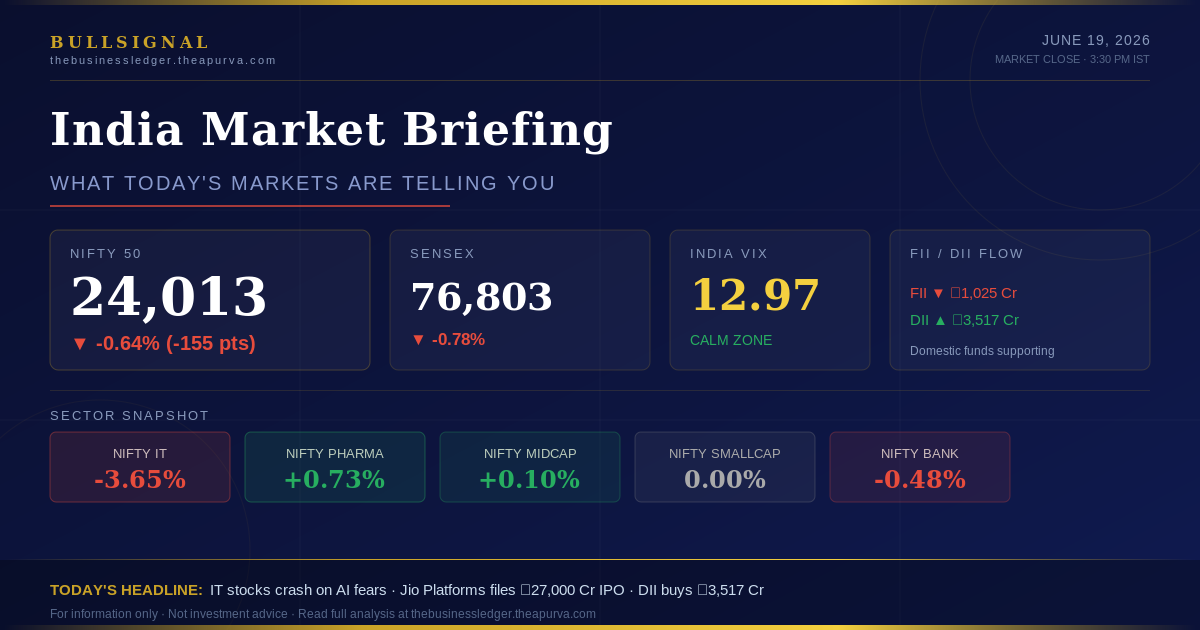
India’s stock markets closed in the red on Friday, June 19, 2026 — with a sharp crash in IT (Information Technology) stocks doing most of the damage. NIFTY 50, which is essentially a report card for India’s 50 biggest companies, closed at 24,013 — down 155 points (-0.64%). SENSEX, the older sibling tracking 30 Bombay Stock Exchange giants, ended at 76,803 — down 607 points (-0.78%).
The intraday damage was worse. During the session, Sensex plunged over 900 points and NIFTY briefly slipped below 24,000, before domestic buyers stepped in and cushioned the fall.
Now the cap-size picture: NIFTY 100 (Large Cap) — which tracks India’s top 100 companies — ended down 0.58%. Meanwhile, NIFTY MIDCAP 50 (mid-sized, fast-growing companies sitting between the giants and startups) actually closed up 0.10%. And NIFTY SMALLCAP (emerging, smaller companies) actually closed up +0.56% — quietly outperforming the large-cap slide.
Translation: the big boys bled today. Mid and small companies not only held their ground — they gained.
Cap Category Breakdown: Mid and Small Caps Beat the Large Caps
Today’s pattern is telling. When large-cap indices fall but mid/small caps stay flat or rise, it usually signals one of two things: either the selloff is concentrated in specific large-cap sectors (in today’s case, IT), or investors are rotating — pulling money out of expensive large caps and parking it in growth-oriented mid-caps.
Today, it was both.
Large Cap movers worth noting:
- 🟢 Bharti Airtel +1.92% — India’s top telecom player continued its strong run, benefiting from data demand growth and stable pricing.
- 🟢 Adani Enterprises +0.83% — Infrastructure and energy giant stayed in positive territory despite broad weakness.
- 🔴 Infosys -6.75% — The single biggest drag on the market today. More on this below.
- 🔴 TCS -3.55% — Tata Consultancy Services joined its IT rival in a brutal session.
Mid Cap standout:
- 🟢 Polycab India +1.79% — India’s leading wires and cables maker bucked the trend. Polycab supplies electrical wiring to homes, factories, and infrastructure projects — and with India’s construction boom continuing, demand for their products remains strong.
- 🔴 Mphasis -2.96% — Mid-cap IT company caught in the same AI-fear wave as the large-cap IT names.
Small Cap movers:
- 🔴 Kaynes Technology -3.91% — The electronics manufacturing company, which makes circuit boards and IoT devices, fell sharply as tech-adjacent stocks got hit in the broader IT rout.
- 🔴 LatentView Analytics -3.28% — A data analytics firm that services large global corporations; fears that AI would replace human data analysts hit this stock hard.
- 🟢 Bikaji Foods +0.05% — Essentially flat, but in a day like this, not falling counts as a small win for the popular snacks brand.
Sectors: The Complete Story Behind Today’s Moves
🔴 NIFTY IT: -3.65% — The Crash That Defined the Day
The IT sector was the story today. Indian IT companies — TCS, Infosys, HCL Technologies, Wipro — earn most of their revenue from global clients, primarily in the US and Europe. They charge in US dollars, but pay salaries and expenses in Indian rupees.
So why the crash? AI disruption fears. Investors are worried that large global companies — which pay Indian IT firms to write software, manage systems, and process data — will increasingly replace those services with AI tools. The fear: if a company can get an AI agent to do in hours what an IT outsourcing team does in weeks, why pay the outsourcing team at all?
Market expert Seshadri Sen put it plainly today: “AI fear over IT is overdone, but near-term pain is likely to persist.” That’s the tension — the long-term reality is more nuanced, but the market is reacting to fear today.
The numbers were brutal intraday: Infosys fell as much as 7.5% during the session, TCS dropped nearly 6%, Tech Mahindra declined 6%, HCL Tech was down 5%. They recovered slightly by close but the damage was significant.
What it means for you: If you work in Indian IT, this selloff reflects global nervousness, not a catastrophic collapse. But if you hold IT stocks or mutual funds heavy in IT, expect turbulence for a few more months as the AI-versus-outsourcing debate plays out.
🟢 NIFTY PHARMA: +0.73% — The Safe Haven
While everything else fell, pharmaceutical companies had a good day. India’s pharma sector is defensive — people don’t stop buying medicines when markets fall. Sun Pharma, Dr. Reddy’s, and other pharma majors attracted investors who wanted to park money somewhere stable.
📊 IOC, BPCL, HPCL: Down ~2-3% — Oil’s Double-Edged Sword
India’s oil marketing companies — IOC (Indian Oil), BPCL (Bharat Petroleum), and HPCL (Hindustan Petroleum) — fell 2-3% today after news that US Vice President JD Vance postponed a Switzerland trip related to US-Iran nuclear talks. That news raised doubts about whether a peace deal with Iran would happen soon.
Why does this matter for India? Iran has been a key oil supplier when relations allow. If talks stall, global oil supplies stay tighter, keeping crude prices elevated. Higher crude oil costs mean IOC, BPCL, and HPCL — which buy oil internationally and sell petrol/diesel domestically — face squeezed margins. Higher oil also ripples into everyday life: costlier transport raises the cost of vegetables, cement, clothes — everything that moves by truck.
Three News Stories That Moved Markets Today
1. Jio Platforms Files for IPO — India’s Biggest Listing Ever?
Reliance Industries’ AGM (Annual General Meeting — the yearly gathering where company leadership announces big decisions) revealed that Jio Platforms, the digital arm of Reliance, has filed its DRHP (Draft Red Herring Prospectus — the first official IPO document) with SEBI for a ₹27,000 crore listing involving 27 crore equity shares.
This is potentially the largest IPO in Indian market history. Jio Platforms is home to Jio Telecom (460+ million subscribers), JioFiber, JioSaavn, and JioCinema — a digital empire that rivals anything in Asia. Mukesh Ambani framed it as a demonstration of India’s potential on the world stage.
Ironically, Reliance’s own stock fell 1.4% today — partly because the broader market was weak and partly because IPO announcements sometimes cause short-term selling pressure as investors anticipate share dilution. But the long-term implication is massive: Jio’s listing will bring transparency, attract global institutional capital, and could reshape India’s tech investment landscape. Watch this space.
2. IT Stocks: Why the “AI Will Kill IT Jobs” Fear Hit Today
Today’s IT carnage wasn’t random — it followed a global narrative building for months. The fear is straightforward: AI coding tools (like GitHub Copilot, Cursor, and newer agentic AI systems) can increasingly write, test, and maintain software. Large Western corporations that outsource these tasks to Indian IT firms are evaluating whether they need as many contracts.
The market overreacted today — experts like Seshadri Sen say the full AI impact on IT revenues is still years away, and India has advantages in cost, scale, and talent that won’t vanish overnight. But the near-term pain is real, and mid-cap IT companies (Mphasis, Persistent, Coforge) are not immune. Several IT stocks are now trading 50-78% below their all-time highs.
For investors: If you have SIP (Systematic Investment Plan — a method of investing a fixed amount monthly into mutual funds) exposure to IT-heavy funds, this is actually an opportunity to accumulate more units at lower prices. Think of it like a sale — you’re buying more shares of good companies for less money.
3. Polycab Bucked the Trend — Why Wires and Cables Are Hot
While IT sold off, Polycab India rose 1.79%, touching ₹10,083 per share. Polycab is India’s number-one wires and cables company, and with India’s infrastructure push — electrification, data centers, housing, EV charging — demand for high-quality cables is growing. The stock’s resilience today signals that investors are rotating into infrastructure-linked companies even as tech gets sold. Infrastructure and manufacturing are the new darlings.
FII vs DII: The Big Money Tug-of-War
FII (Foreign Institutional Investors) are big overseas funds — think US pension funds, European hedge funds, Singapore sovereign wealth funds. They move large amounts of money across global markets based on macro factors like currency, interest rates, and global risk appetite.
DII (Domestic Institutional Investors) are Indian mutual funds, insurance companies like LIC, and domestic banks.
Today’s scorecard: FII sold ₹1,025 crore. DII bought ₹3,517 crore.
The foreign money was heading for the exit — likely because of global IT concerns, Iran-oil uncertainty, and general risk-off sentiment. But domestic investors — your mutual fund SIPs, LIC premiums, EPF contributions — absorbed every rupee the foreigners threw at the market. This DII backstop is why the market recovered from its intraday lows. Domestic investors are essentially acting as a safety net, reflecting growing confidence in India’s long-term story even when global mood turns negative.
India VIX: The Market’s Fear Thermometer
India VIX closed at 12.97, up slightly from yesterday (+2.37%). Think of VIX as a measure of how nervous the market is. Below 15 means calm. 15-20 means mild worry. Above 20 means investors are scared.
Despite the IT selloff and intraday volatility, VIX at 12.97 tells us the market is not in panic mode. Traders expect normal fluctuations — not a crisis. The smart money is not heading for the bunkers yet.
Real-World Impact: How Today’s Market Connects to Your Life
Petrol prices: The Iran talks stall could keep oil prices elevated through July. If crude stays above $75/barrel, domestic petrol and diesel prices could face upward pressure. Your Ola/Uber fares may inch up.
Home loans: The IT sector’s rough patch could nudge companies toward caution on hiring and expansion. But RBI’s (Reserve Bank of India) interest rate trajectory remains supportive — the central bank has been on a rate-cutting path this year, which means home loan EMIs have been easing. Watch the next RBI policy meeting for signals.
Job market: If you’re in Indian IT, the AI-disruption narrative is noise in the short term but a real challenge to manage over 3-5 years. Upskilling in AI tools — rather than competing against them — is the career playbook.
SIP investors: Markets fell today. That means your next SIP installment buys more units at a lower price. Think of it exactly like a grocery sale — you’re getting more of what you want for the same money. Panic-selling when markets fall is the #1 mistake retail investors make.
What to Watch Tomorrow (June 20, 2026)
-
US-Iran talks clarity: Any news from JD Vance’s rescheduled diplomatic meetings could swing oil prices sharply. If talks progress → oil falls → IOC/BPCL/HPCL rally → petrol price pressure eases.
-
IT stocks stabilization: After a brutal session, watch whether buyers step in at lower levels in Infosys and TCS. If they do, it signals the selloff is overdone. If they sell again, the sector could test new lows.
-
Jio IPO buzz: Institutional investors and analysts will begin dissecting Jio Platforms’ DRHP over the weekend. Initial valuations estimates will emerge — expect significant media coverage. Reliance stock could recover if the IPO valuation impresses markets.
Markets close at 3:30 PM IST every weekday. This briefing is for information and education only — not investment advice. Always consult a SEBI-registered financial advisor before making investment decisions.
Sources: NSE/BSE closing data via Yahoo Finance, FII/DII provisional data via NSE, news from public market disclosures. This briefing is for education only — not investment advice.
Created with Claude AI