Good Morning — Here’s What Happened While You Slept
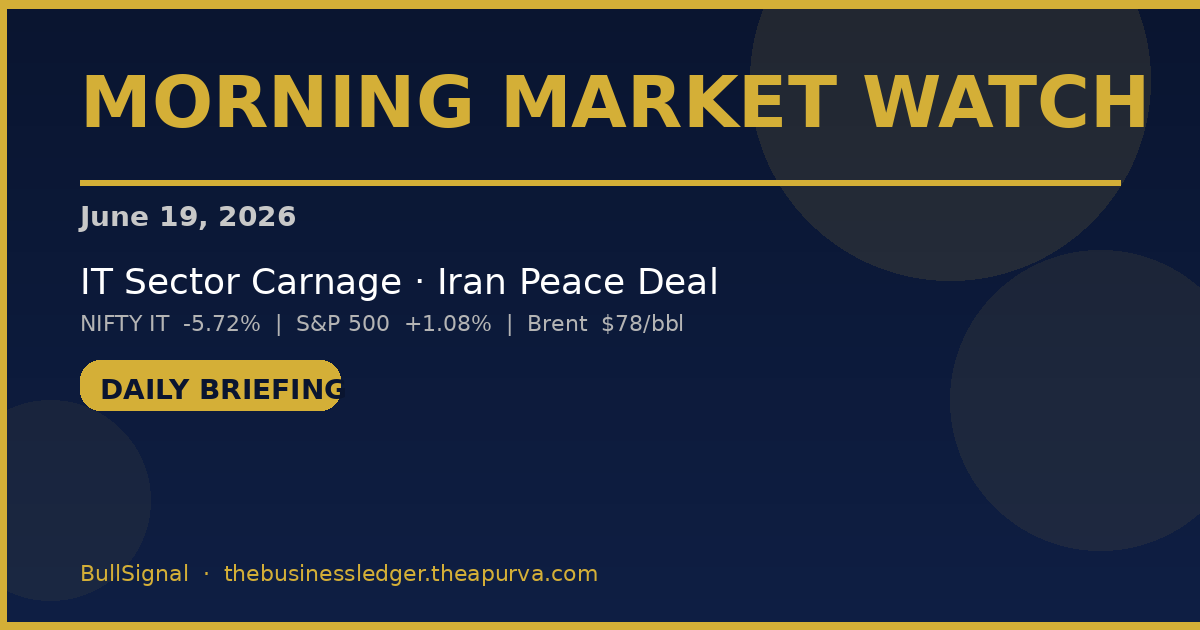
Yesterday’s market session told a tale of two worlds. While Wall Street bounced back strongly — the S&P 500 rose 1.08% and the Nasdaq surged 1.91% — Indian markets had a very different Thursday. The NIFTY 50 dropped 199 points (-0.82%) to close at 23,968. But the real bloodbath? India’s IT sector collapsed 5.72% in a single day. Let’s break it all down.
1. Opening Snapshot — How Did Yesterday Close?
Think of the NIFTY as a scoreboard tracking India’s 50 biggest companies. When it falls, most of those companies’ stock prices dropped. Yesterday, NIFTY closed at 23,968 — down 0.82%.
But here’s what’s interesting about the cap segments — different “sizes” of companies behaved very differently. What’s a “cap”? Market capitalisation (cap) is the total value of a company’s shares. Large caps are India’s giant companies, mid caps are the ambitious growers, and small caps are the emerging underdogs.
- NIFTY 100 (Large Cap) — India’s top 100 companies — closed at 25,056, down 0.70%.
- NIFTY MIDCAP 50 — Medium-sized, fast-growing companies — fell just 0.37% to 17,650. Relatively resilient.
- NIFTY SMALLCAP — Smaller, emerging businesses — was completely flat at 18,698.
The clear pattern: the bigger the company, the harder it fell yesterday. Mid and small cap investors held up surprisingly well. The drag came almost entirely from large-cap IT giants.
2. Yesterday’s Star Movers by Cap Segment
🏦 Large Cap — IT Dominated the Damage
Infosys was yesterday’s biggest large-cap casualty, crashing 8.14% — enormous for a blue-chip. TCS fell 6.03%, HCL Technologies dropped 5.04%, and Wipro slid 3.66%. Why? We’ll explain in a moment — it all comes down to one American company.
On the brighter side: Titan (+0.73%), Adani Enterprises (+0.72%), and Bharti Airtel (+0.52%) finished in the green. Reliance Industries inched up +0.38%. Consumer and telecom showed the market is not panicking broadly — it’s a targeted IT sell-off.
📊 Mid Cap — IT Firms Got Hit Hard Here Too
Mphasis fell 6.06%, Persistent Systems dropped 4.56%, and Coforge declined 3.03%. These mid-sized IT companies suffered right alongside their bigger peers. Polycab (-0.30%) and Dixon (-1.70%) escaped with relatively minor damage compared to the IT pack.
🌱 Small Cap — The Island of Calm
Campus Activewear rose 1.93% — a bright spot. Bikaji Foods edged up 0.23%. LatentView Analytics fell 4.80% (it’s a data analytics firm, so in the IT bucket). Kaynes Technology dipped 1.75%. Overall, small caps were the least impacted segment of the day.
3. The Story Driving Everything: Accenture’s Bombshell
Here’s the central story behind yesterday’s IT crash, explained simply.
Accenture is one of the world’s largest technology consulting companies — US-headquartered, with an estimated 3+ lakh employees in India. It’s closely watched because when Accenture’s business grows, Indian IT companies like Infosys, TCS, and Wipro usually benefit. They do much of the same work: helping global companies upgrade their software, build digital systems, and manage data.
Accenture reported disappointing quarterly earnings and trimmed its full-year revenue growth forecast to just 3–4%, down from 3–5%. New bookings fell to $19.3 billion. Accenture’s stock crashed 14% in the US.
The message markets read: global companies are slowing their technology spending. If clients are cutting IT budgets with Accenture, they’re likely doing the same with Infosys and TCS. That fear drove the Indian IT sell-off.
For everyday life: if IT companies face slower growth, they slow down hiring. It’s one reason why the tech job market has felt cautious lately.
4. Global Overnight Recap — Why Wall Street Rose While We Fell
Here’s the puzzle: US markets closed very strong last night. S&P 500 gained 1.08% to 26,517, Nasdaq surged 1.91% to 7,500, and Dow edged up 0.14% to 51,564. So why did Indian markets fall?
Timing. The Accenture report hit during US Wednesday hours. India had its first full session to react on Thursday. The US had already moved on to the next positive catalyst: the Iran peace deal.
The Iran Peace Deal: A US-Iran peace agreement is being formally signed today (June 19) in Switzerland. Iran is a major oil producer. War risk or sanctions mean restricted supply and higher oil prices. Peace means more oil flowing, which pushes prices down. Brent crude has retreated to around $78 per barrel — a three-month low.
Why does cheaper oil matter for India? India imports roughly 85% of its oil needs. Every dollar drop in crude saves India billions. Lower oil → lower petrol and diesel → lower transport costs → lower prices for everyday goods you buy. This is genuinely good news.
Asian markets gave a mixed picture on Thursday. Japan’s Nikkei climbed a strong 1.82%, crossing the 71,000 mark for the first time, buoyed by global peace optimism and a weaker yen. Hong Kong’s Hang Seng fell 1.08% and Shanghai dipped 0.25% amid China’s ongoing property sector concerns.
The Fed factor: US Federal Reserve kept rates unchanged but signalled possible hikes later in 2026. Higher US rates mean US bonds offer better returns — which can pull foreign money OUT of Indian markets and back to the US. This is a backdrop concern that keeps FII flows under pressure.
5. Crude Oil & Rupee Check
- Brent Crude: ~₹78/barrel (falling, Iran deal relief)
- USD/INR: ~94.3 (the rupee has been gradually strengthening — it traded at 94.53 on June 16, moved to 94.29 on June 17)
A stronger rupee is good news in general — imports cost less. But it’s a headwind for IT exporters: they earn in dollars, and a stronger rupee means those dollar revenues convert to fewer rupees. That’s another quiet pressure on IT margins.
For mid-cap industrials like Kaynes Technology and Polycab, lower crude means cheaper raw material inputs (plastics, energy). A modest tailwind for their margins.
6. FII vs DII Flows — The Tug of War
FIIs (Foreign Institutional Investors) are global fund managers who invest in Indian markets. DIIs (Domestic Institutional Investors) are Indian mutual funds, insurance companies, and pension funds. Think of it as foreign money vs. homegrown Indian savings.
Yesterday’s June 18 data: FIIs sold ₹1,025 crore worth of Indian stocks — foreign investors pulling back on IT weakness. But here’s the reassuring part: DIIs bought ₹3,517 crore. Indian investors more than offset foreign selling. This is healthy — it means domestic confidence in India’s long-term story remains intact, even when global sentiment wobbles.
That DII cushion is likely why NIFTY’s fall was contained to 0.82% rather than a sharper correction.
7. Key Sectors and Cap Segments to Watch Today
IT & Mid-Cap IT (TCS, Infosys, Persistent, Mphasis, Coforge): The sell-off may not be done. Further Accenture analysis could extend the pain. Watch for brokerage analyst notes and management commentary.
Pharma (Defensive, NIFTY Pharma +0.18% yesterday): When global uncertainty rises, investors move money to “defensive” sectors — pharma and FMCG — because people buy medicines and household goods regardless of economic cycles. Pharma could see continued buying.
Oil & Gas (ONGC, Reliance): Lower crude is mixed — good for Reliance’s refining margins, but slightly negative for pure oil producers like ONGC whose earnings depend on oil price. Watch crude’s direction as the Iran deal is signed today.
Banking large caps + SEBI catalyst: SEBI board is meeting today to consider open-market share buybacks — a mechanism where companies repurchase their own shares. This tends to support stock prices. If approved, watch HDFC Bank, ICICI Bank, and SBI for a positive reaction.
8. Three Things to Watch Today
1. SEBI Board Meeting (Today, Friday) SEBI is considering allowing open-market share buybacks again. If approved, it’s bullish for cash-rich companies — especially banks, FMCG majors, and IT firms sitting on cash reserves. The outcome today could shift afternoon trading sentiment.
2. Iran Deal Signing — Oil Price Direction The peace deal is signed in Switzerland today. If crude falls further toward $75–76, that’s a real tailwind for auto companies (lower raw material costs), airlines (cheaper fuel), and broadly for India’s inflation outlook. Watch oil markets in the afternoon.
3. IT Sector Stabilisation Will Infosys and TCS find buyers after the 6–8% crash, or does institutional selling continue? Any stabilisation here — especially if US tech holds its gains overnight — would lift the NIFTY meaningfully from yesterday’s close.
9. One Tip for SIP Investors
Markets fell yesterday because of IT-specific news — not because India’s economic fundamentals changed. A PM-KISAN transfer of ₹18,880 crore to 9.44 crore farmers is happening on June 20, which pumps money directly into rural consumption. India’s domestic economy continues on its course.
Your SIP in a diversified fund is automatically buying more units at lower prices today. That is exactly how rupee-cost averaging works — you’re getting more shares for the same monthly amount. Don’t pause your SIP during volatility; that’s giving up the exact benefit you signed up for.
If you hold IT-sector specific funds, use this moment to reflect on your overall sectoral exposure — but for diversified investors, this is noise on a long journey.
Created with Claude AI