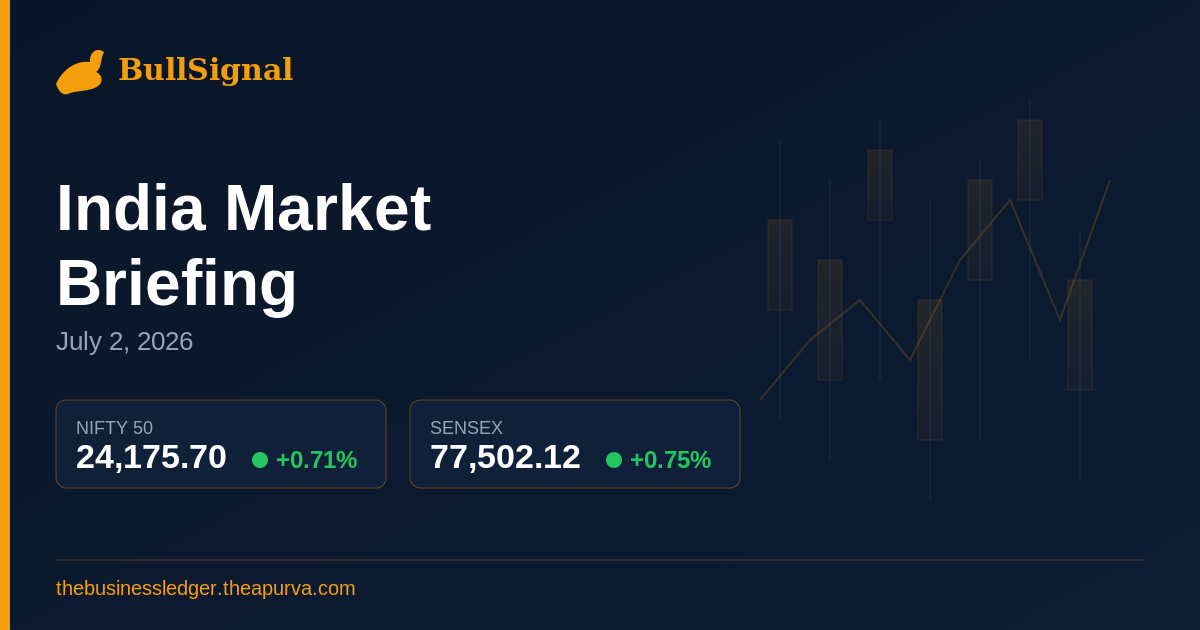
If you checked your phone at 3:30 PM today, you saw green. NIFTY 50 closed at 24,175.70, up 169.85 points, or 0.71%. SENSEX finished at 77,502.12, up 579.48 points, or 0.75%. Think of NIFTY as a report card for India’s 50 biggest, most-traded companies — when it rises, it means investors put more money into these businesses today than they took out.
But the real story of the day is one level below the headline number. NIFTY 100 (which tracks the top 100 companies — the “Large Caps,” the safest, most established names) rose 0.66%. NIFTY MIDCAP 50 (mid-size, fast-growing companies) rose a more modest 0.51%. And NIFTY SMALLCAP (smaller, higher-risk, higher-reward companies) jumped 1.25% — nearly double the pace of the large caps.
That ordering matters. When smallcaps outrun both large and mid caps, it usually means investors are feeling confident enough to chase growth over safety. It’s the market equivalent of people feeling comfortable enough to take a chance on a new restaurant instead of ordering from the usual place.
Large, Mid, and Small Cap: Who Won, Who Didn’t
Large Caps: Infosys led with a 5.64% gain, followed by TCS at 4.31% — both riding a broader IT rally we’ll get to shortly. On the losing side, Larsen & Toubro slipped 0.81% and Reliance Industries eased 0.34%, both fairly minor pullbacks in an otherwise green session.
Mid Caps: Persistent Systems surged 5.78% and Mphasis climbed 5.58% — again, IT-linked names benefiting from sector-wide buying. The lone decliner among the mid-cap leaders was Polycab India, down 0.81% — everything else in this basket finished higher.
Small Caps: LatentView Analytics jumped 5.56% and Bikaji Foods added 1.10%. Campus Activewear was the only one in the red, dipping a slight 0.17% — essentially flat.
Notice the pattern: this wasn’t really a “large vs. small” story so much as an “IT vs. everything else” story. IT-linked names dominated the gainers list across all three cap categories.
Sectors: Why IT Roared and What Else Moved
NIFTY IT was the standout, up 4.64% — the sharpest sector move of the day by a wide margin. TCS (+4.31%), Infosys (+5.64%), HCL Technologies (+4.24%), Tech Mahindra (+7.17%), Coforge (+5.19%) and Mphasis (+5.58%) all rallied hard. Part of this looks tied to sentiment: TCS announced it hired over 1,500 students from an Andhra Pradesh university today, a hiring signal that often reads as a company expecting more work to staff up for. It’s worth noting this rally happened even as Wall Street’s own AI-fuelled tech rally showed signs of cooling overnight — a reminder that Indian IT stocks don’t always move in lockstep with their US tech cousins; sometimes local buying takes over the story.
Energy told a clear cause-and-effect story. Brent crude fell to around $67.74 a barrel, down roughly 1.2%, its lowest level since late February, as easing US-Iran tensions and a pickup in shipping through the Strait of Hormuz eased supply fears. India imports about 85% of its oil, so cheaper crude is good news for companies that buy crude and sell fuel — oil marketing companies BPCL (+2.05%) and HPCL (+1.90%) rose because lower input costs mean fatter margins on every litre they sell.
NIFTY AUTO gained 1.32%, led by Mahindra & Mahindra (+2.53%) and Tata Motors’ commercial vehicle business (+2.10%) — autos tend to benefit from cheaper fuel too, since it supports both consumer demand and company logistics costs.
Banking was the odd one out, essentially flat (NIFTY BANK -0.00%). ICICI Bank (+1.46%) and SBI (+0.40%) gained, but Bank of Baroda fell sharply, down 4.20%, dragging the sector average down and offsetting the gains elsewhere.
The News Behind the Numbers
The clearest thread connecting today’s move: falling crude prices lifted broad market sentiment while IT stocks did the heavy lifting on returns — exactly the dynamic financial media flagged this afternoon. Separately, Nithin Kamath of Zerodha weighed in publicly on why retail investors may be better served by ETFs than individual stock-picking — a reminder for anyone starting out that diversified, low-cost index investing is often the more forgiving path than trying to pick individual winners.
FII vs DII: Who Bought, Who Sold
FII (Foreign Institutional Investors) are large overseas funds — think US pension funds, European banks, global hedge funds — buying and selling Indian stocks from abroad. DII (Domestic Institutional Investors) are Indian mutual funds, insurance companies, and banks doing the same from within the country.
Today, FIIs were net sellers of ₹311.82 crore, while DIIs were strong net buyers at ₹1,784.40 crore. In plain terms: foreign money pulled back slightly, but domestic institutions — largely your mutual fund SIPs pooled together — more than made up the difference. This has been a recurring pattern lately, and it’s one reason Indian markets have stayed resilient even on days when foreign flows turn negative.
India VIX: The Fear Gauge
VIX measures how nervous the market is about big swings in the near future. Below 15 is calm, 15–20 is mild worry, and above 20 means investors are bracing for turbulence. India VIX fell sharply today, down 7.19% to 12.29 — solidly in calm territory. A falling VIX alongside rising smallcaps is a classic “risk-on” combination: investors aren’t pricing in much near-term danger, so they’re willing to reach for higher-growth, higher-risk names.
What This Means for You
If you drive a car or scooter, cheaper crude is a small tailwind for pump prices in the weeks ahead, though retail fuel prices in India don’t always move immediately with global crude. If you’re a salaried employee in IT services, today’s hiring news and sector rally are a mildly encouraging signal for the sector’s near-term outlook. If you run a monthly SIP, today changes nothing about your strategy — the DII buying you saw today is, in part, funds like yours being deployed steadily regardless of daily noise. And if you’re watching home loan rates, a calm VIX and steady DII flows generally support a stable rate environment, though nothing here directly moves RBI policy.
What to Watch Tomorrow
US jobs data: Markets are awaiting an upcoming US employment report; a weak or strong number could shift global risk appetite and ripple into Indian markets at the open.
Crude oil trajectory: With Iran reportedly shipping over 40 million barrels since the naval blockade lifted and Russian exports at record levels, continued oversupply could keep pressuring prices lower — a net positive for Indian energy importers if it holds.
Whether IT’s rally has legs: A single strong day doesn’t confirm a trend. Watch whether IT majors sustain today’s buying into the next session, or whether it was a one-day sentiment pop tied to the hiring headline.
Sources: NSE/BSE closing data via Yahoo Finance, FII/DII provisional data via NSE, news from public market disclosures. This briefing is for education only — not investment advice.
Created with Claude AI