What Happened Today — In Plain English
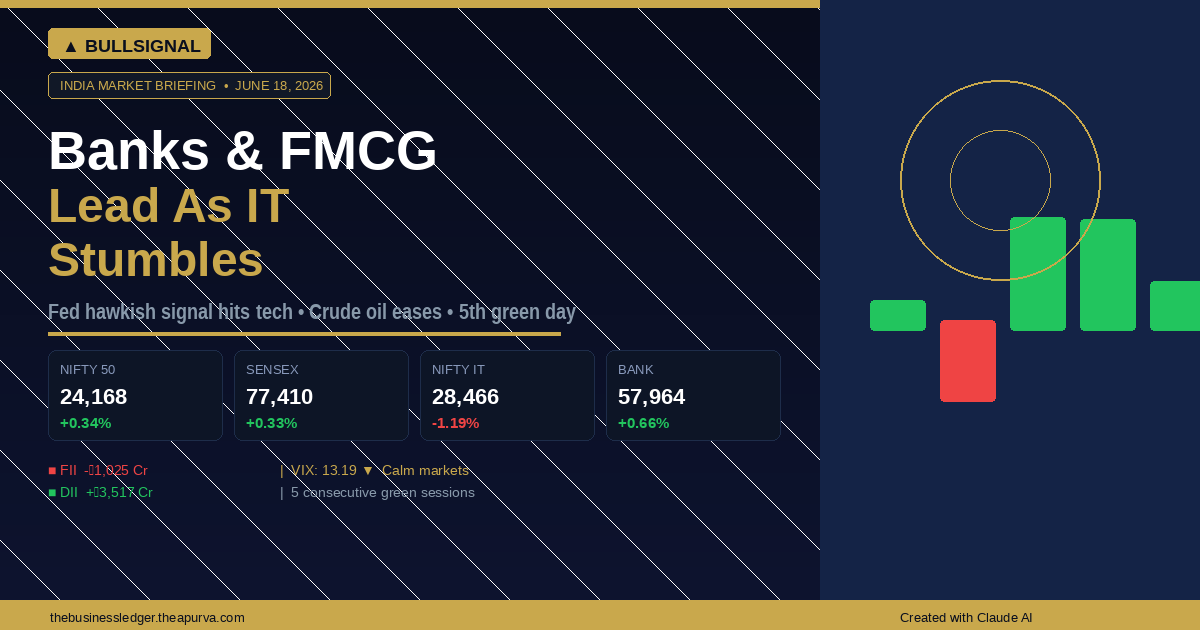
Imagine the stock market as the mood of a very large, very anxious group of people — all trying to guess what tomorrow holds. Today, most of them felt cautiously optimistic. The NIFTY 50 — an index that tracks India’s 50 most important companies — closed at 24,168 points, up 0.34%. The SENSEX, which tracks 30 top companies listed on BSE, ended at 77,410 points, up 0.33%.
This was the fifth straight day of gains. Think of it like a winning streak in cricket — the crowd is confident, the players are in form, and the momentum is real. But today’s session wasn’t without drama. One big sector — technology stocks — stumbled badly. Let’s understand exactly why.
The Big Story — Two Forces Shaped Today’s Market
Force 1: America’s New Central Bank Chief Scared IT Investors
Here’s something that surprises most people: what happens in Washington DC can move Indian stocks within hours.
Here’s why. Kevin Warsh, the new head of America’s central bank (called the Federal Reserve or “the Fed”), held a major meeting yesterday. He kept interest rates unchanged for now — but signalled clearly that rates might go up later this year. Nine out of eighteen Fed officials expect a rate hike in 2026.
Now, why does this matter for Indian IT companies like TCS and Infosys?
Think of it this way: when US interest rates rise, money flowing from big American and European funds into developing countries like India tends to slow down or reverse. These large foreign investors — called FIIs (Foreign Institutional Investors) — start finding better returns back home in the US. So they pull money out of Indian stocks. And IT companies, which are highly popular with these foreign investors, take the first hit.
Today, Infosys fell 2.61%, Persistent Systems dropped 2.07%, and Tech Mahindra slid 1.01%. The Nifty IT index fell 1.19% overall.
The takeaway: When the US Fed signals higher rates, think of it as American investors calling their money back home. Indian IT stocks are usually the first to feel it.
Force 2: A Truce in the Middle East Is Slowly Cooling Crude Oil Prices
India imports nearly 85% of its oil from abroad. The Middle East is the source of much of it. Earlier this year, a conflict between the US and Iran sent crude oil prices soaring — which hurt India badly, because expensive oil means expensive petrol, diesel, cooking gas, and plastics.
But now, a US-Iran ceasefire is being extended, and oil prices have cooled significantly from their 2026 peaks. This was good news for India today — lower crude oil means lower input costs for manufacturers, less pressure on the government’s fuel subsidy bills, and a slightly happier rupee.
The takeaway: Peace in the Middle East = cheaper oil for India = lower petrol prices = a small relief for your household budget.
Sectoral Winners and Losers — Explained Simply
🏦 Banking — Rose 0.66% | The Quiet Pillar
Banks had a solid day. HDFC Bank rose 1.51%, SBI jumped 1.58%, and insurance companies like ICICI Prudential Life (+3.66%) and Max Health (+6.27%) powered ahead.
Why? Lower crude oil means less inflation pressure, which reduces the urgency for India’s central bank (RBI) to raise interest rates. When rates stay stable, banks can lend more freely and earn more. Stable interest rates also mean your home loan EMI is less likely to go up soon.
What this means for you: Your home loan, car loan, or personal loan EMI stays roughly where it is. No nasty surprises from the bank next month.
🚗 Auto — Rose 1.72% | The Sector Everyone Forgot to Watch
Auto was today’s star performer. Bosch surged 2.05%, Eicher Motors climbed 1.23%. The auto sector benefits doubly from lower oil — as a manufacturer (steel and plastic inputs cost less) and as a product (cheaper petrol makes consumers more willing to drive, and to buy new vehicles).
What this means for you: If you’ve been thinking of buying a car or two-wheeler, the economic conditions are tilting in your favour.
🛒 FMCG — Rose 1.69% | Your Daily Grocery Basket Is Feeling Better
FMCG stands for Fast-Moving Consumer Goods — companies that make things you buy and use every week: soap, biscuits, shampoo, cooking oil. Marico rose 1.96%, HUL gained 0.95%, Britannia added 0.25%.
These companies buy raw materials like palm oil, crude derivatives, and packaging material. When crude oil falls, their input costs drop and profits rise. Investors noticed.
What this means for you: Lower raw material costs for FMCG companies often eventually mean more stable prices — or even small discounts — on everyday items at your kirana store or supermarket.
💻 IT — Fell 1.19% | The Fed’s Collateral Damage
As explained above, IT bore the brunt of the Fed’s hawkish stance. This is worth understanding more deeply: India’s IT companies earn most of their revenue from US and European clients, paid in dollars or euros. They’re incredibly exposed to anything that changes how global capital flows.
When foreign investors sell IT stocks, the share prices of TCS and Infosys fall — but the companies themselves haven’t changed. They’re still profitable, still growing. It’s investor sentiment that shifted, not business reality.
What this means for you: If you hold an IT mutual fund, today was a rough day. But IT companies remain fundamentally strong. These dips are often temporary.
FII vs DII — The Tug of War India Is Winning
Today’s FII/DII data tells a fascinating story.
FIIs (Foreign Institutional Investors) — large overseas funds from the US, Europe, Japan — sold ₹1,025 crore worth of Indian stocks today. Think of them as foreign guests at a party who heard rumours the drinks are better somewhere else.
DIIs (Domestic Institutional Investors) — Indian funds like LIC, SBI Mutual Fund, HDFC AMC — bought ₹3,517 crore. They’re the loyal hosts of the party, holding things together.
The DIIs buying nearly 3.5x what FIIs sold is a powerful signal. It shows that Indian institutions have confidence in Indian markets — and they’re happy to buy shares at current prices when foreigners exit.
The takeaway: When FIIs leave, Indian funds are stepping up. This is what market maturity looks like.
India VIX — The Fear Thermometer
India VIX is the market’s “fear index.” A low number means calm, predictable markets. A high number means investors are nervous and big swings are expected.
Today, VIX stood at 13.19, down 1.27%. This is a healthy, low reading. Markets are calm despite global noise from the Fed.
What this means for you: If you’ve been waiting for a “safe” time to start a SIP or add to your mutual funds, a low VIX environment is generally considered more stable.
How Today Connects to Your Daily Life
Let’s make this tangible:
- Cheaper crude oil → petrol and diesel prices may ease slightly in the coming weeks → your auto-rickshaw fare and home cooking gas cylinder cost could nudge down
- IT stocks falling → IT companies may slow hiring or freeze bonuses short-term → if you or someone you know works in tech, watch out for salary review signals
- Banking stocks rising + low VIX → stable lending environment → good time to lock in a home loan if you’ve been planning to buy property
- FMCG rising → companies like HUL and Marico benefit from lower input costs → the gap between your biscuit’s MRP and what the manufacturer earns is widening in their favour → don’t expect prices to drop overnight, but the pressure to raise prices is easing
What to Watch Tomorrow
-
US Inflation Data — Numbers release tonight (US time). If US inflation comes in hotter than expected, expect the Fed hawkishness to intensify, which could cause more FII selling in Indian IT and financial stocks tomorrow morning.
-
Crude Oil Prices — The Iran ceasefire is still fragile. Any flare-up or rejection of the deal could spike crude prices again, hitting aviation, paints, FMCG, and auto stocks hard.
-
Broader Market Breadth — The NIFTY Midcap and Smallcap indices have been running in sync with the large-caps. Watch if small-cap stocks continue their momentum or start losing steam — that’s usually an early signal of whether the rally has real depth.
India’s market is on a 5-day winning streak, but beneath the surface, global forces — a hawkish US Fed and a fragile Middle East peace — are quietly shaping every sector. Stay curious, stay informed.
Created with Claude AI | BullSignal — thebusinessledger.theapurva.com